Terms and Conditions of Use

All content on this blog/website is the intellectual property of the website owner. Unauthorized use is prohibited. Content may be copied or shared only after receiving permission by the owner. This includes all text, information, and photos on the blog.

Sunday, May 22, 2016

Handlines, Handlines, Handlines

Growing up, moving handlines was one of the least enjoyable jobs on the farm.  It ranked right up there with picking rocks.  But, it had to be done.

For a lot of children, work is used as a punishment.  As a result, the word 'work' has a negative connotation attached to it.  This is a factor that arguably contributes to the rising generation of lazy people.  Work (especially hard/dirty jobs) is something fewer and fewer people want to do because it is looked down on as bad or not fun.

One goal we have with our kids is to teach them that work can be fun.  That is actually not as difficult as we thought at first.  It is really all about the attitude you take with you towards doing a job.  Since there are still handlines that need moved/started on the farm, we decided that this would be a good opportunity to teach our kids that working can be fun.  A few times a week, some (or all) of us will go out to start a handline on the pasture.

One of the most liberating things for a child is doing a 'grownup' task all by themselves.  So, when we go out to start a handline on the pasture, they are in charge of putting the pipes together and hooking them.  The best part is that this is the one time where they get to tell me what to do.  As we put each pipe together, they tell me when to push, and after they get them hooked, they tell me when to pull to take the slack out of the line.  Once the line is together G and R each get out a little 6 inch piece of wire and walk down the line to unplug any nozzles that are plugged up.

G. recently became aware that he's strong enough to carry one end of the pipes.
Following my orders of "in in in in in........ PULL!!!"
Moving on to the next pipe.

R. being the 'hook man'

Putting pipes together.
R. coming dangerously close to getting water down his boots.

R. and A. waiting to help hook the next pipe into the line.


Unplugging a nozzle.


Success!  Each unplugged nozzle is accompanied by a cheer and a happy dance.

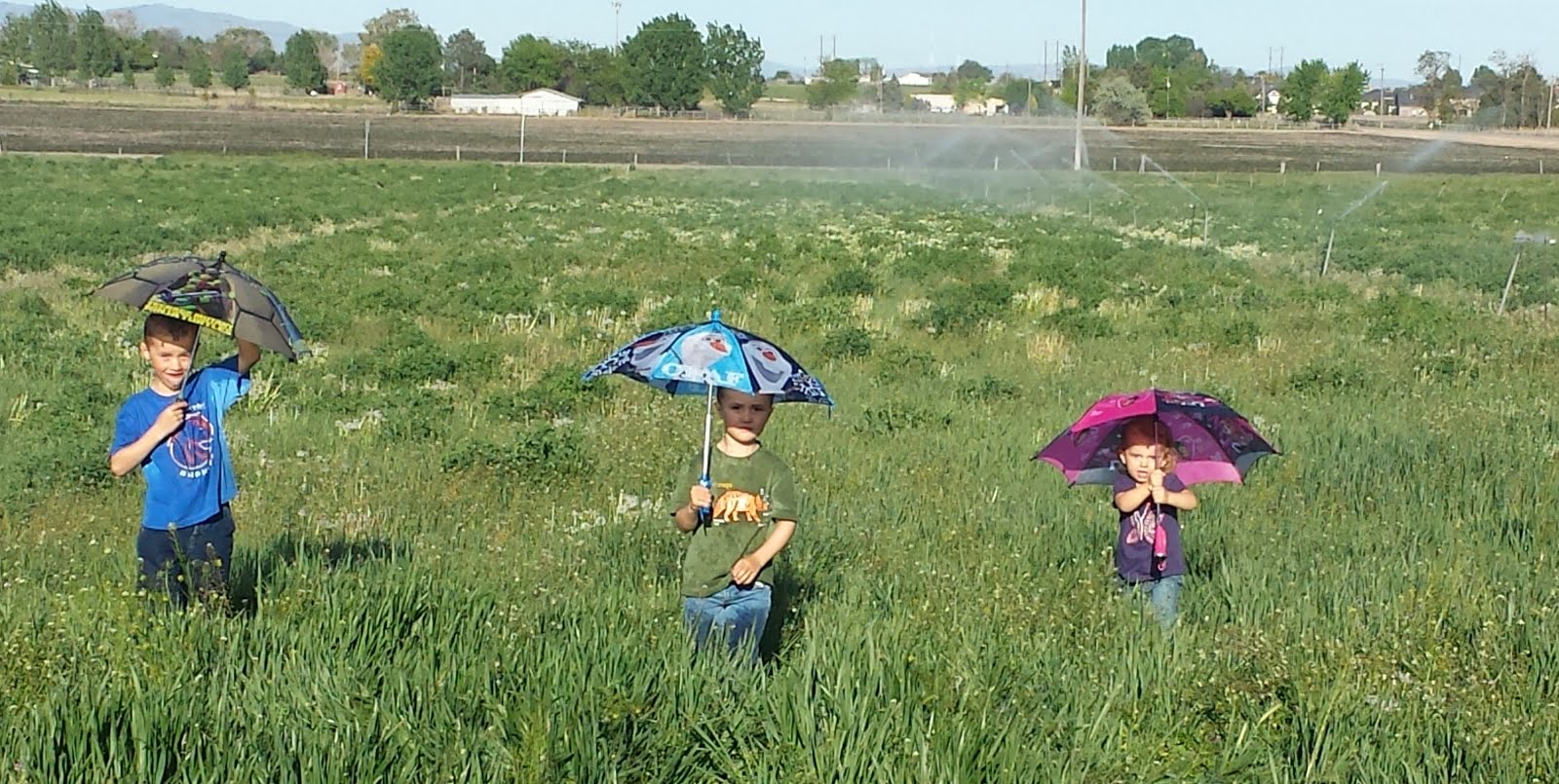
After the line is going, that's when the fun really begins.  Last year one of their great Grandmas bought them some umbrellas.  Since we live in a desert climate and only get 10-12 inches of annual precipitation (if we're lucky), it was very unlikely that those umbrellas would ever be used in the rain.  So, we found another way to get some use out of them.  As we head toward the opposite end of the pasture, the kids get out their umbrellas and have a great time playing in the water.


A pipe with a crack in it is better than a splash pad at a water park.


Her interests lie mainly in picking flowers and stomping in puddles.


Whether we like it or not, a large portion of our lives is spent working.  The best thing you can do for yourself and your family is to find work you can enjoy, and find a way to enjoy the work you are doing.  I realize that this is not always possible.  However, with the right attitude you can enjoy more of the work you do, more easily tolerate the unpleasant jobs you can't avoid, and set a good example for the little ones who watch everything you do.

Sunday, May 8, 2016

The Crooked Wheel Lines of Our Lives

In the life of a farmer, irrigation systems are both a blessing and a curse.  When they work the way they're supposed to, they can make your life much easier.  When there is a problem, however, it can cost a lot in both time and money to get the problems rectified and the water flowing again.


A few weeks ago my family and I went out to the field to work on getting the wheel lines straightened up and ready for irrigation season to start.  A wheel line is an aluminum sprinkler line that has a 5 or 6 foot tall metal spoked wheel on every 40 foot section of 4 inch pipe.  In the center of the line there is a mover, which is a metal frame mounted on 4 wheels with a 6 to 8 horsepower motor that will roll an entire 1/4 mile line back and fourth across the field.  They work well, are easy to move, and grow excellent crops.  Wheel lines have but one [giant] flaw.  They do not travel straight.  Even if they are exactly perpendicular to the main line (which supplies the necessary water) a slight slope or gradual hill somewhere in the field can cause the entire line to shift one way or another and become crooked.  If the proper steps are not taken to straighten the line and get it to follow its tracks when it comes back across the field again, two things can happen.  After going back and fourth across the field a few more times it can move so far away from the main line that the hose or pipe used to connect it will no longer reach.  It could also get a bow in the line that becomes so crooked one of the pipes will break under the pressure.


While we were in the midst of straightening out the above pictured wheel line and re-attaching the end pipes, the thought crossed my mind that fixing a crooked wheel line is a metaphor for life.

Often times we can see where we want to go in life and we may even see how to get there.  It can even seem like a simple and easy path to follow to reach our goal.  But, like a wheel line moving across a field, as we travel an unexpected bump in the path can, over time, throw off the whole journey.  If you ignore the bumps in the field and challenges you need to face in life, they will only become larger problems that will be harder (and more costly) to deal with later on.  They might even make it impossible for you to get to where you want to go.

So, how do you get a wheel line (and your life) back on track and headed in the right direction?  When you notice that the line is starting to go off course, you steer it back to where it needs to be.  Starting at the mover, you walk down one side of the line and move each wheel forward (or backward) a foot or two.  Day after day, as the wheel line continues on across the field, it will gradually move back into its tracks from the previous trip.  When it starts to move out of line again, do the same thing again and bring it back to where it should be.

The same approach can be taken in our lives as well.  When as a problem or dilemma arises, do what it takes to take care of it right away, so you can move on.  Then you move on.  Dwelling on the troubles you've had in the past does no good.  You look back only to see where you've been and to help you know where you are heading.

If you take those simple steps to keep your wheel lines straight, sprinkler lines (and lives) can travel smoothly and grow some beautiful things as the journey continues.


A straight wheel line is a happy wheel line.


Sunday, May 1, 2016

2016 Sweet Corn


We're growing some sweet corn to sell again this year. We tried it last year and it turned out pretty good (in spite of my wife having a baby the first day we were selling it).  This year we are going to plant a few more rows and hopefully improve on last year.  I'll update this post as the growing season progresses.

In March, when things started turning green, I went and marked out the corn plot and sprayed it with a non-selective herbicide.


4/16/16 (3 weeks after spray was applied)

R. and I went out on the Mule with corn seed and a single row planter to plant the first 15 rows of corn.


It had been long enough since area was sprayed that the Field Bindweed (a.k.a. Morning Glory) and some volunteer wheat was coming back nicely.  After the corn was planted we put the 8 foot spray boom on the 4-wheeler and sprayed the plot with herbicide again.  The soil in this field is heavily populated with dormant Mourning Glory seeds, which can remain viable for up to 50 years (http://www.nwcb.wa.gov/detail.asp?weed=39).  It is a weed that is nearly impossible to get rid of.  Seeds can spread by hitching a ride on farm equipment, be blown about by the wind, and can even pass through an animal and still sprout.  If given a chance, this noxious weed will take over and almost completely choke out a crop.  We are trying to keep it at bay until the corn comes up and can establish itself in the soil.

Once the corn is about 3 to 4 inches tall we'll plant our second round of corn.  We will do a total of 3 staggered plantings to spread the corn out so it won't all be ready at once.

A very proud helper.  He was in charge of refilling the planter and raking dirt over any seed left exposed behind it.
April 24th.

Watered for the first time.

G. cleaning out corrugates.


May 14th

Re-corrugated and planted second round of corn seed.


Saturday, May 28th


Watered corn for the second time. 
Friday, June 3rd

The family went out and pulled weeds.


Pulling weeds, or looking for worms?


Saturday, June 4th

You have probably noticed in some of the pictures that there is a large variance in the sizes of corn plants in the rows of corn.  Also, there is no uniformity in spacing in between plants.  Some are so close together they form their own little forest, while others have almost 2 feet between them.  
While it is possible that these inconsistencies were caused by the person who planted the seed (me), I believe that the problem lies with the Earth Way single row planter I used to plant the seed.  It works great in a garden, but is lousy in a field.  It is too lightweight.  The corn seed gets caught in the little hopper and stops the plate from turning, and it has a hard time dropping only one seed at a time.  It is, however, still a step up from planting by hand.  


Thinking ahead to next year, we have been looking for a tractor driven 2 or 4 row planter to buy.  On June 4th we went to a farm auction in Meridian to try and pick one up.  This was a 6 row John Deere 71 Flex planter. We weren't really looking for one that big, but for the right price we could make it work.  Between an auctioneer my wife and I have both known since we were little helping us out and other bidders taking pity on me as I stood there with a bunch of clingy kids that were bouncing all around, we ended up getting that planter for a fraction of what we expected.  Unfortunately, since our corn is already planted. now I have to wait a year before we can actually use it.


At the farm sale, just got our planter loaded.
Tying down the planter.

Friday, April 22, 2016

A Helping Hand

The evening of Friday, February 26th, 2016:  With my Dad out of town for a few days, we were doing his feeding and taking care of things for him.  When filling up a water trough for the beef cattle, my wife noticed something odd.  All the cows came up to the manger except for one.  When it is feeding time and and a cow doesn't come up to eat, it is a big deal.  They are either sick or injured, and timely care can sometimes make the difference between life and death.

As she took a closer look, she noticed that the cow had just given birth, and the place she chose to do so was right next to a deep, mucky corner of the pen.  This poor little calf, in trying to stand up and take his first steps, had managed to get himself down in a hole and was stuck.  His mama was standing there, licking him off, trying to help him up, but could do nothing for him.  As soon as I came home from work, I changed my clothes as fast as I could and ran up to see what we could do.


To our great fortune the cow calved close to the fence, so getting to the calf was not difficult.  I was not familiar with this particular cow and had no idea what her temperament was going to be like.  All the beef cattle are pretty docile, but when a cow has a calf, that can change.  The most dangerous place in the world is between a mother cow and her new baby calf.   But, we needed to help the calf.  I decided to chance it and climbed over the fence and down next to the calf.  The cow stood about 6 feet from me.  As soon as I grabbed onto the calf and started pulling, she snorted, bawled, and closed the gap between us, sending me scrambling back up over the fence.  So much for plan A.

Feeling that our time was running short to save this little calf, we quickly formed a plan B.  Reaching through the fence, I was able to slip a rope around the calf's neck and pull him out of the muck and through the fence, out of the pen.  That angry mama (later to be named 'Grouchy') head butted the fence rails a couple times and just about came through after her calf (and me).  I ran and got my loader tractor and put the calf in the bucket.  Driving around to the front of the pen, I opened the gate, pulled the tractor in, and set the bucket down to show the cow where her calf was.  After a couple of minutes she found him.  With the cow now sticking like a magnet to the front of the tractor, I backed out of the pen and over into a smaller pen used mainly for sick cattle.  Halfway there, though the cow became distracted by my barking dog and went after him for a minute.  I hurried and backed the tractor into the pen, jumped off, and ran to get the cow turned around and shewed back over to her baby.  She finally ran into the pen with the calf and I closed the gate behind her.

My moment of jubilation was cut short, as I realized that my tractor was still in the pen, and this distressed mama had just about enough of me for one day.  I wasn't sure how we would get it out.  She gave me the death glare as I climbed up on the fence, then started snorting and pawing at the ground when I made a move to get down off the fence to get on the tractor.  It was about ten feet away from the fence, and I needed to get it out of the pen.  Standing on top of a fence post (railroad tie), I took a flying leap, and to my great surprise, actually stuck the landing on the tractor!  I looked over at my wife, who was staring at me with wide eyes and her mouth open.  I still don't know if it was a look of admiration at what I had just done, or a look of disbelief that I would attempt such a thing.


With the tractor now outside the pen, we backed off and left them alone for a few minutes.  Grouchy eventually calmed down and went back to licking her baby off and trying to get him up.  We waited and watched to make sure the calf was going to be okay.  We weren't sure how long it had been since the calf had been born, but it had to have been at least a couple of hours.  Newborn calves typically stand up on their own and start looking for food about a half hour after being born.  This calf could hardly hold its head up.  He did try to stand a couple of times, but only to fall back down and lay flat on his side for a couple minutes.  He seemed to have exhausted all his energy while he was stuck in the muck, and now was too tired to stand up and drink the colostrum that would keep him alive.

We made a quick trip to town and bought some colostrum replacer to feed the calf.  Now the only problem was that the cow was still on the fight and not about to let us get anywhere near her baby.  The only solution was to repeat what we did the first time and rope the calf, now in the middle of the pen, and pull him out through the fence again.

I got a lariat rope and, standing at the fence on the outside of the pen,  managed to get a loop around his neck.  We slid him out of the pen and gave him the milk with a probe bottle.  He was too weak to stand, but still put up some good resistance towards having a tube placed in his throat.  Once we got it all down into his stomach we slipped him back through the gate and in with his mama.  After that, we fed the cow and called it a night.  That was all we could do.  In the morning the calf would either be up and around, or dead.

The next morning, to our great surprise, the calf was not just up and walking around, but was actually trying to jump and play.  The cow's teats were sucked clean and her udder hung empty.  We kept a close eye on him all day Saturday and Sunday, but he seemed to be out of danger and doing well.

Expressing the 'I am going to eat you for lunch' look.


This was a great lesson for our kids, who witnessed the entire ordeal from safely inside our van, on having compassion for animals and putting everything you've got into helping someone and solving a problem.  I enjoy working with cattle and am glad this story had a happy ending.

Helping someone in need always makes you feel good.

Saturday, April 16, 2016

The Hardest of the Hard Things

As a parent, one of the hardest things you have to deal with is health problems with your children.  That is simply because there is little to nothing you can do to take away their pain and make things better for them.

When one of our children was born, he had a virus and a couple other complications that landed him in the NICU for the first week of his life.  He was 5 days old before my wife got to hold him for the first time.  We soon after discovered he had severe food allergies.  Because of his struggles at birth he also had a weakened immune system, which basically meant that he got sick every time we went to town.  The first few years of his life were difficult for all of us.


An unforeseen source of difficulty during that time was the lack of understanding and compassion people tend to have for children with food allergies and medical complexities.  When our son was old enough to start eating regular food, we had to be very careful with what he ate.  Any exposure to food containing dairy, peanuts, eggs, tomatoes, or barley would result in hives, severe abdominal discomfort/pain, followed by 2-5 days of diarrhea.  The pediatrician equipped us with an epi-pen and trained us on what to do if he had a severe allergic reaction.

All of our friends and extended family knew about our son's food allergies, but some of them didn't really understand or seem to believe us.  They acted like we were just being unnecessarily strict and superstitious.  When we went to family gatherings we had to watch him closely, because some people, who felt bad for him, would try to give him things he could not have.

A few times things did get slipped past us.  Once someone stuck a spoonful of whipped cream in his mouth, and another time he was given a glass of 2% milk.  When the milk was handed to him it spilled all over his arm and mouth, which instantly broke out in hives.  The shocked look on that person's face when they saw the blemishes appear on his skin was something I'll never forget.

Around the time he turned 3 we were able to began introducing foods he had been allergic to in his diet.  Today he has completely outgrown all of his food allergies.  What a blessing it has been for him to be transformed into a healthy regular kid.  What a blessing it has been for my wife and I to be able to empathize with other parents who are dealing with similar issues with their children.  Some struggles you can only fully comprehend after you have been there yourself.


Through those hard times with our son we received a lot of help and advice from my sister, who had a child that was dealing with medical issues far more complicated and severe than what we had faced.  Brandis knew what we were dealing with, and we now understood a little better about what she and her family had faced over the last few years. To see her blog, go to: agirlandhertube.blogspot.com.

There are 3 things we learned during the first 3 years with our son:

1. Even though his struggles were a difficult trial for us, we didn't have to look very far to find someone who had it much worse than we did.  We had a niece that required a feeding tube, a relative with Crones disease, and we also were friends with a family whose daughter had been recently been diagnosed with leukemia.  We were fortunate, because our son had the possibility of outgrowing his medical issues.

2.  If a parent has one or more of their children on a 'weird' diet, respect their wishes!  Though it may be tempting, conducting your own experiments on their kids by giving them foods they aren't supposed to have will never yield positive results.

3.It doesn't do any good to spend time feeling sorry for yourself and comparing your problems and issues with those of people who appear to 'have it easy'.  Everyone is fighting a different battle, some just can't be seen from the outside.


While in the pursuit of happiness, one should stop, and just be happy. -Eleanor Roosevelt


Friday, April 8, 2016

Tails of Gold

March 26th 2016

There are a few types of creatures in existence that are of questionable purpose.  Skunks, mosquitoes, and yes, you guessed it, gophers.  The only benefit they can offer is a meal for their predators when they get caught.

On flood irrigated ground gophers are driven to the ditchbanks and outer perimeter of the field where it is easier to stay out of the water when it comes.  But, because sprinkler irrigation systems don't saturate their tunnels with water and either drown them or force them to relocate, gophers thrive in fields irrigated by handlines, wheel lines, and center pivots.  In spite of many efforts to eradicate them, since the farm's sprinkler irrigation system was put in in about 1995, the gophers have been gradually increasing in population.

In June of 2014, I took my boys, then ages 4 and 2, out to the field with one of my old box traps so I could show them what a gopher looked like in real life.  The first two times we set the trap the gopher plugged it with dirt.  On our third try we finally caught one.  It was big, ugly, and had the nastiest teeth and claws ever seen before.  I told the G. and R. about how you can cut their tails off, take them in to the irrigation district office, and get a dollar for each one.  They were so excited that we had to keep setting that trap so we could get more gopher tails.  I rounded up a couple more traps and we were officially in the gopher trapping business.

There are 3 reasons we are doing this:
- It is an opportunity for my family to spend a little time working together outside every day.
- It is an opportunity for my children to earn a little money and learn about working hard for it. (most purchases in town are discussed in terms of how many gophers they had to catch to pay for it).
- It is an opportunity to help reduce crop loss and equipment breakdowns caused by gopher mounds.

Since June 12th, 2014, we have caught more than 535 gophers on the farm.  In 2 of the fields we trap in it is finally starting to appear as though the gopher population is in a decline.  We have actually had a difficult time finding fresh gopher mounds to set our traps in.  But, we are far from running ourselves our of business.  There are other fields we haven't been able to trap in as much.
First gopher of the year

Below are pictures of our young gopher trapping professionals and how they identify recent gopher activity, dig the fresh gopher mounds, find the holes, and set the traps.


Step 1.  Find a fresh gopher mound.  There are two ways to do this.  Either look for dark brown dirt mounds, or simply follow the dog.  He has a high success rate of identifying good holes to set traps in.


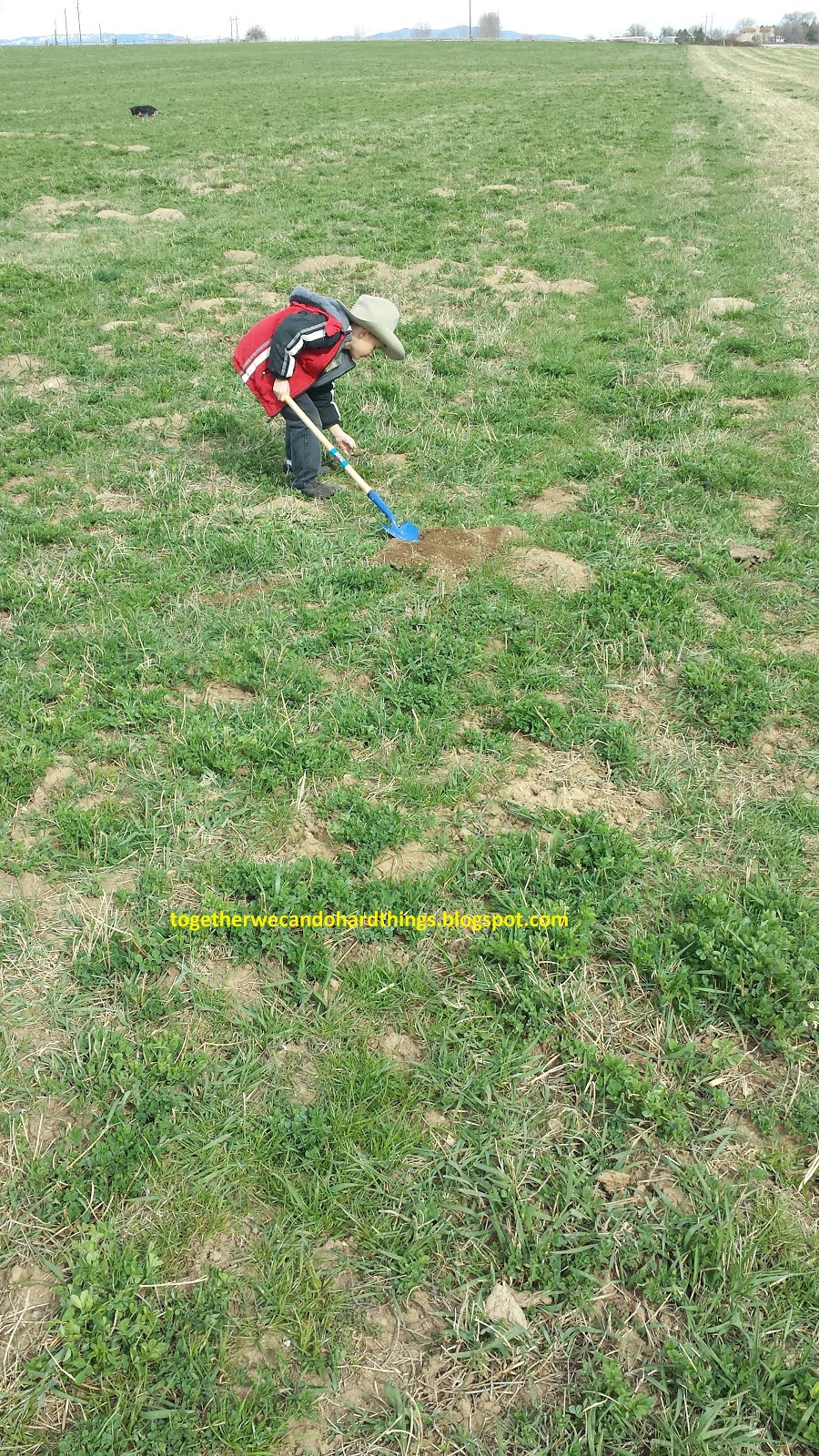
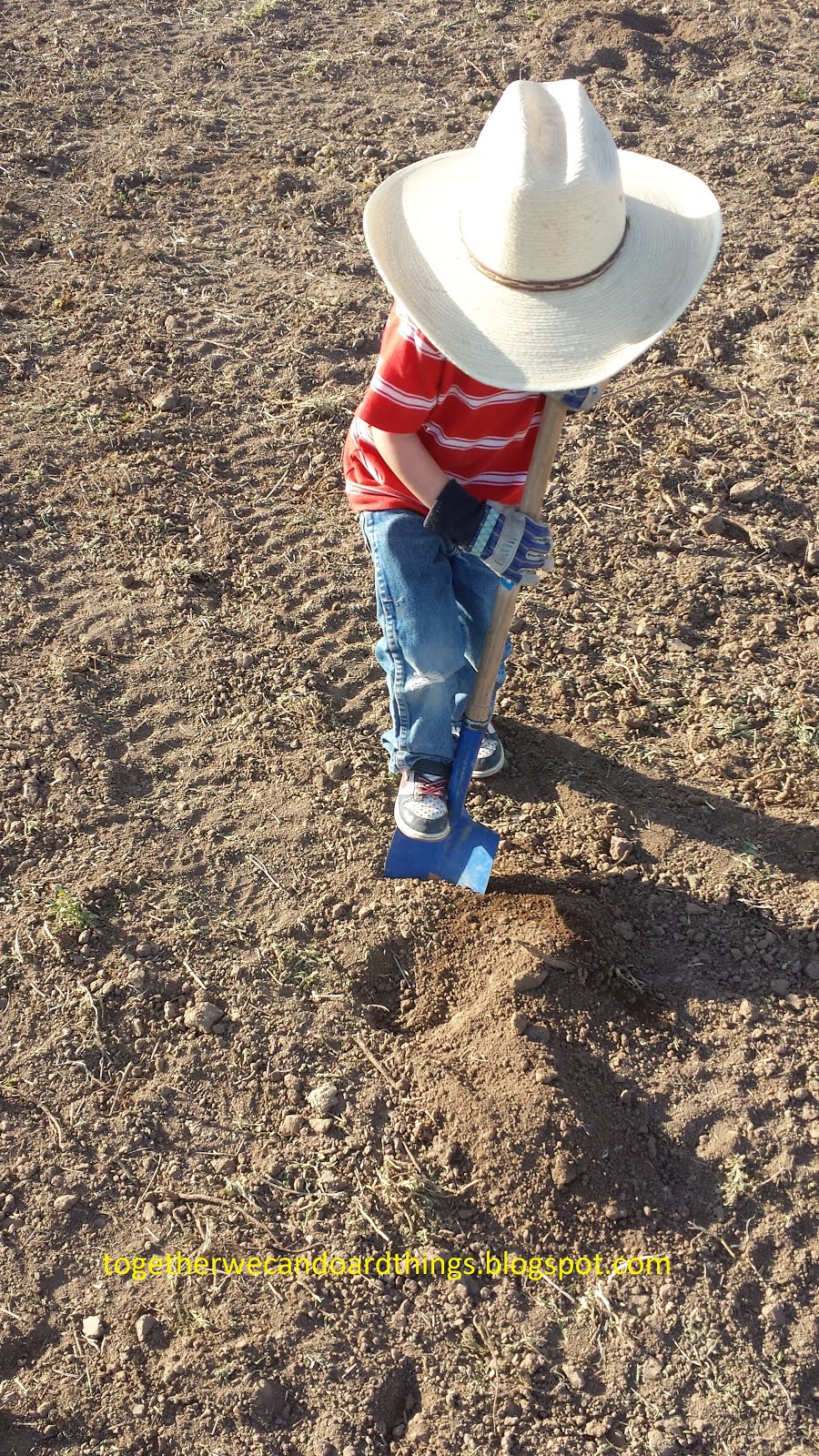
Step 2.  Find the circle in the mound and start digging.  On a typical fresh gopher mound you should be able to find the hole after removing 2-4 shovels full of dirt.


Step 3.  Stop everything to pick some blooming weeds.


Step 4: Clear out the entrance and smooth the dirt in front of the hole.  (Keep in mind that gophers will bite fingers).  Set the mechanism on the trap and carefully place it directly in front of the hole.  Lightly cover all the gaps between the trap and the hole (except for the hole in the back of the trap) with dirt.  Mark with a flag, and you're done!


Step 5:  Pull up the traps.  After 24 hours, any trap that is not set off will either be plugged or was set in an abandoned hole, so pull them all up.


After you have completed steps 1-5, you will hopefully have a gopher caught.  The last step is to smile and do a happy dance (and then fill in the hole).


Trapping gophers may seem like an odd topic to spend so much time doing and talking about, but this has turned into valuable and rewarding family time for us.  This is one thing we do together, but you don't have to live on a farm or trap gophers to find new ways to bond with your kids.  For the innovative thinker, opportunities are everywhere for families to spend time together doing fun things that will create fond memories at little to no cost.

_

_